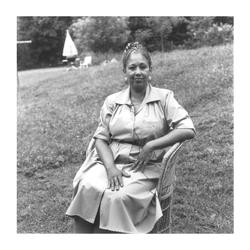
Anita Gray McClelland
Wardell Gray's daughter
Anita Gray McClelland:
It just seems like it would be more interesting if you were asking me
questions and I was answering and you were sitting here beside me and
somebody was filming it. This is just too dry, I don't like this. If you
were asking me..you know..what else would you be doing..or you'd be doing
this and this and this and then..because this is just too dumb..this is
dumb. I want you to hear this radio interview yesterday.
Abraham:
I understand exactly what you're saying...
Anita:
Because that was good but this is just really..I sound like a big dummy.
Abraham:
One of the things I'm interested in as I mentioned to you is that I want
to talk to people who had an involvement with him at a certain level. And
I realize you want to keep it positive, but on another level there's also
a reality to a life and not necessarily it all being rosy. So the fact is
that your father, who was a well known musician who I'm interested in also
was a person, a human being with foibles , with mistakes that he made. And
on some level I think you've expressed to me your frustration and your
anger that he left you and you never really knew him.
Anita:
But I'm so thankful that now I'm beginning to know who he was.
Abraham:
Right. right. So I think, I don't know, I mean, it's up to you really to
what degree you want to respond to that or not.
Anita:
I think it's important.
Abraham:
I think so too. (Sounds of Abraham coming into the camera frame making
sure he's in the film). Can you see us now? You got it? Alright, so do you
want to respond to that question? In the beginning you said it was
important about not knowing your father in a sense of you only knew him
for basically about two weeks. And what that leaves with you now, what is
it about thirty-five forty years later.
Anita:
Although there is some anger about being left and not being able to live
with my father, I do appreciate the fact that he and my mother made
arrangements for me to live in good homes. First, his sister helped my
grandmother to raise me and she did the best of everything she could for
me. Good clothes, good schools. She helped me through the school of
cosmetology and introduced me to first class entertainment by other people
and was always there for me when she was living. So it helps some to know
that someone in the family sort of made up for what he didn't do. So I
feel really good about the rest of the family being there for me. But I do
feel frustrated still and angry due to the fact that I didn't get the
chance to spend very much time with him. Only short periods of time like
back stage and going to the job sites wherever he played. Being too young
and having to go through the conflict of being allowed to be in the place,
a lot of times they wouldn't want any children in and he would say well if
my daughter can't come in then I'm not going to play. So they would allow
me to come in so I got quite a few chances to go in night clubs before I
was even twelve years old. But still it wasn't like having a father and
mother together to grow up with daily so I don't really feel good about
that but I do feel good about the times I did get to spend with him. Such
as the times learning to cook and watching him rehearse, I enjoyed
watching his rehearsals and asking different questions. I used to try to
get him to play melodies all the time, you know he would play the West
Coast style which was
progressive, called progressive Jazz and I didn't really understand it as
a child and I'd always want to hear the melody and he told me I don't play
melodies this is the way I play, this is the style I play.
Abraham:
Was he aware that he was a great player?
Anita:
Yes he was aware of it and he wouldn't mind letting you know. He used to
stand in front of the mirror and practice the dexterity of his fingers and
the reason he used the mirror was I guess so he could practice both
backwards and forwards and still be able to play with the speed that he
wanted to play. And so he spent a lot of time studying and writing.
Abraham:
So is it better now when I sit next to you like this?
Anita :
Oh is it...